Lightweighting is emerging as a critical strategic focus for new energy vehicles seeking to enhance their core competitiveness. Recently, Mingyue Lake Laboratory, in collaboration with local enterprises in Chongqing, has successfully developed a high-performance magnesium alloy electric drive housing. Test data indicate that the housing achieves a 30% reduction in overall weight, marking a substantive breakthrough in improving whole-vehicle energy efficiency.

In the Liangjiang Collaborative Innovation Zone, numerous high-endR&D institutions are situated along the shores of Mingyue Lake. (File photo)Photo by Zhang Jinhui, Reporter of Chongqing Daily
The electric drive housing is a core component of the powertrain in new energy vehicles, and its weight directly impacts the vehicle's driving range and energy consumption. Although magnesium alloys are hailed as the "lightest engineering metal," their inherent limitations—such as insufficient heat resistance and relatively poor corrosion resistance—have long hindered their large-scale application in critical automotive components.
The R&D team carried out systematic technical research across three dimensions: materials, structure and manufacturing processes, addressing the key bottlenecks that have constrained industrial development one by one.
On the materials front, by incorporating rare-earth elements and optimizing multi-component microalloying compositions, the team improved the material’s overall performance by roughly 20% compared with conventional solutions. On the structural front, with topological optimization and repeated design iterations, the housing achieved an overall 30% weight reduction. This translates to a 4%–6% reduction in energy consumption per 100 km under the same battery capacity. On the process front, the team pioneered semi-solid die-casting technology. The finished parts feature high density, excellent dimensional accuracy, and are manufactured through a greener, low-carbon process.
To meet automotive corrosion-resistance requirements, the parts receive multi-layer anti-corrosion surface treatments. They can withstand more than 1,080 hours of salt spray testing, making them suitable for diverse and demanding operating conditions.
Currently, the team from Mingyue Lake Laboratory is working with industrial partners to carry out process optimization and production line commissioning for magnesium alloy electric drive housings. Mass production is expected in the first half of 2027.
According to the team lead, through coordinated optimization of liquidus temperature, strength and toughness, and corrosion resistance, the team has developed a range of injection-molded magnesium alloys. These alloys are suitable for broad applications including electric drive housings, wheels, instrument panel crossbeams and communication equipment housings, with the liquidus temperature controlled at approximately 600 °C.
The team has also developed a series of highly corrosion-resistant magnesium alloys through purification processes and alloy composition optimization. As an example, by adjusting zinc content, the newly developed high-strength and high-thermal-conductivity magnesium alloy reaches an ultimate tensile strength of 259 MPa, yield strength of 113 MPa, elongation of 18.7%, and thermal conductivity of 131.9 W·K⁻¹·m⁻¹.
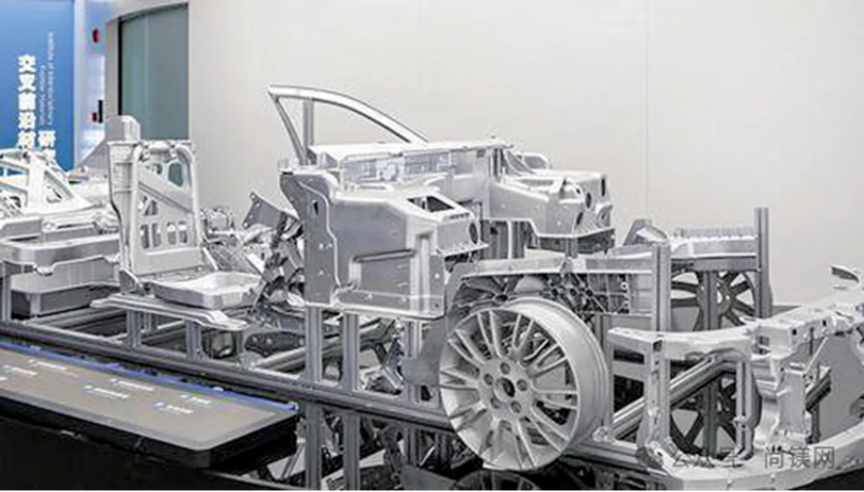
Lightweight magnesium alloy automotive components, including front-end structures, wheel hubs and crash beams, on display at the Mingyue Lake Laboratory exhibition hall. (File photo) Photo by Jinhui Zhang, Chongqing Daily
Last year, with mass production as the development target, the team successfully developed the world’s largest one-piece die-cast magnesium alloy rear body structure, delivering 12 technological breakthroughs from scratch. The component reduces overall vehicle weight by 21.8% and boosts overall performance by more than 10%. Compared with aluminum alloy alternatives, it reduces life-cycle carbon emissions by 15%, doubles electromagnetic shielding effectiveness, and improves damping performance by a factor of 2.5.
In addition, working with leading domestic enterprises, the team has developed products such as magnesium alloy battery pack housings, magnesium alloy parts for two-wheelers, semi-solid injection-molded magnesium alloy wheel hubs and instrument panel brackets. All these products have achieved large-scale production and entered the market.
Source: Liangjiang Collaborative Innovation Zone
This article is reprinted from Sunlight Magnesium Network.
Original title: “30% weight reduction! Mingyue Lake Laboratory has overcome technical challenges in magnesium alloy electric drive housings, with mass production expected next year”.
Original link:https://mp.weixin.qq.com/s/Ubnpgwf4v3oWyuiTR_l1DA


 International Mg Society